
Case Study: Deep Impact
What We Talk About When We Talk About Conflict, Part 2

Before we get started, this post is technically Part 2 of What We Talk About When We Talk About Conflict. I think it’s most useful to discuss a writing thing and then walk through a piece of media that does that same thing well or poorly, but that post was already north of 2,000 words, so it felt like a good decision to break it up. Still, if you haven’t read that post, I’d encourage you to do so, so we’re all on the same page re: character decisions and consequences.
Also, a note: the lack of real decisions/followed-through consequences is extremely common in novels, and I would love to give some examples because they’re really instructive. But a good rule of thumb is not to poop where you eat, so with case studies, I’ll be using examples from film and TV.
Spoilers ahead.
Deep Impact is a 1998 sci-fi disaster movie where an extinction-level asteroid is headed for Earth and a crew from NASA has been sent to destroy said asteroid before it hits. Ha ha, just kidding. I mean, all of that happens, but the actual meat of the story is a bunch of characters completely unrelated to this mission having big feelings about the forecast complete annihilation of all life on Earth. You see, before it ever hits, this asteroid is having a deep emotional impact. Here’s the trailer.
It also has possibly one of the most hilarious and awkward car explosions in film history.
If you can’t already tell, I don’t think this movie is very good. Defenders tend to point out it’s more scientifically accurate than Armageddon, which has a similar plot and was released the same year. I don’t think it’s really fair to compare these two movies — other than a few overarching plot elements, they’re very different. Deep Impact positions itself as a drama about the human condition and then does most of the drama things pretty poorly. Armageddon is a turn-off-your-brain-fuck-yeah-let’s-kill-an-asteroid-with-the-power-of-bad-science-and-America summer blockbuster, and it does that pretty well. It’s a fun movie! Apples to apples, sure, the human drama elements of Armageddon are also nothing to write home about, but they’re also not why you watch Armageddon.
Therefore, to me, defending Deep Impact based on its superior scientific accuracy sort of feels like the artsy equivalent of saying, “I know my boyfriend is an excruciatingly boring buzzkill, but he knows more elements of the periodic table than that goofy dumbass over there.”
Anyways, moving on.
One of the emotional subplots in Deep Impact is about Tea Leoni’s journalist character, Jenny. When the movie opens, we learn that Jenny’s father has recently left her mother to marry a much younger woman, creating a rift between them. During this time, Jenny manages to get the scoop on the asteroid headed for Earth, which the government is trying to hide from the world, fearing mass panic. As the world prepares for both the long shot chance of destroying the asteroid and certain doom, Jenny, having become the most trusted newswoman in America, is given a coveted spot in one of the few asteroid-proof shelters.
After the attempt to destroy the asteroid fails, her mother commits suicide. Jenny confronts her father about what a piece of shit he is and learns he has been left by his hot young wife. Shortly before impact, while Jenny is preparing to evacuate to the shelter, her father shows up, offering her special photos from her happy childhood in an attempt to reconcile with her. She refuses. Then, staring down the barrel of the incoming asteroid, she gives up her spot in the shelter and goes to her father to reconcile and then die with him.
While this summary might feel like it’s rife with interpersonal conflict, watching this story feels like a slog. There’s plenty of conflict, sure – there’s that big asteroid on the way, Jenny’s father is shacking up with Mrs. Utah, her mom kills herself. But all of these things just happen to Jenny. When Jenny finally has some opportunities to make decisions about her relationships, they’re mostly the fake kind. Take her confrontation with her father after her mother’s death:
Jenny’s available decisions in this scene are:
Option A: Confront my father about his cruelty in abandoning my mother because I am angry and grieving and feel abandoned by him
Option B: Forgive my father because ???
Seriously. Why would she ever pick Option B? We’ve only ever seen them estranged. Their first interaction in the movie is him guilting her over not coming to his wedding to a woman who’s like, two years older than she is! And her mom was cool! The writing did a lot of great character work with her mom, and he’s kind of the reason why she’s dead. Now, he seems like he’s only reaching out because his hot wife has left him. If I was Jenny, I wouldn’t want to be around him either. What does she have to gain in forgiving him?
And I hear you: “But that’s her father! He’s the only parent she has left!” But you can’t bank on the idea that everyone in your audience has a great relationship with their dad and is going to project all of those emotions onto this guy. You have to do the hard work of building this relationship so we can understand what is being lost or gained. The conflict is straightforward, but the consequences feel very amorphous and undefined. Thus, the movie has to rely on a lot of visual signaling to make up for it — It’s raining! She’s wet! Inside his car is dry! She should forgive him so she can be dry!
Likewise, when her father appears before the asteroid impact to give her pictures from her childhood, he’s not risking anything being here. His new wife has already left him! What does he have to lose? His available decisions are:
Option A: Try to reconcile with my daughter and maybe don’t die alone in a horrible asteroid impact
Option B: Die alone in a horrible asteroid impact
Of course he chooses the first option! Who wouldn’t? And because he doesn’t give anything up, this feels less like a genuine act of contrition and more like scumbag gonna scumbag.
I’m not arguing that this relationship needed to be fundamentally different to work — this movie obviously wanted to represent the messy reality of human relations, and scummy fathers are a real thing. I am arguing that in not giving either character real decisions, we have no reason to care about this relationship, and so there is no tension.
And the movie knows this! Which is why, when Jenny abandons her seat in the shelter and goes to be with her father, the movie has to cheat.
The scene of her evacuating should be a tense, cathartic culmination of the conflict she feels over her father and their relationship, and her deciding to give up the rest of her life to be with him in his final moments because she loves and forgives him and doesn’t want him to be alone. Instead, this scene has nothing to do with that conflict! All of the tension is based on if Jenny will give up her seat to a literal child. She grabs the photos her father gave her before the scene starts, but it’s a blink-and-you’ll-miss-it moment.
So while Jenny’s sacrificing her seat feels right overall in the shape-of-the-story sense, the motivations underlying it are all over the place. She gives up her seat to a mother and child and then goes to reconcile with her dad because . . . lol why not she’s gonna die anyways?
And because the final reconciliation between her and her father isn’t based on mutual sacrifice with real consequences, her father’s lack of emotion at her showing up at the end feels both correct and totally goofy. Why isn’t he horrified she’s given up her spot in the shelter to be here? Instead, it’s like they’re seeing each other in line for coffee!
“Hello daughter. Here to die with me when you were one of the few people on Earth with access to a shelter that ensured your survival? Good to see you.”
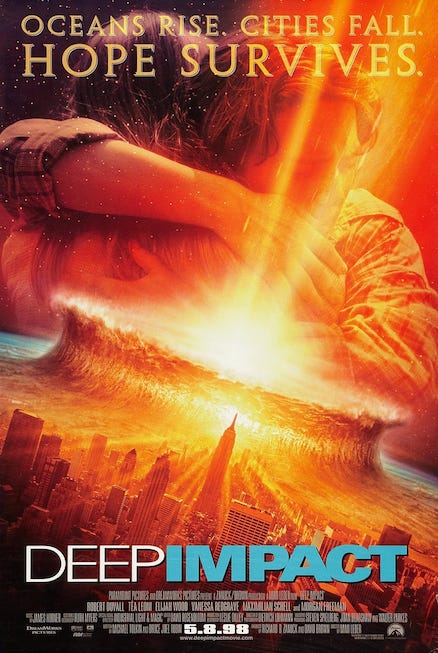
Which leads to the ending image of Jenny and her father being blasted away by a giant impact wave. I suspect this was one of the first images the screenwriter decided on, and it is arresting and beautiful. But the thing about the decision/consequence process of creating conflict is, the story can get away from you. If you want certain things to happen, if you have an idea or an image that just has to be there, you’re much more likely to fall for pretend-decisions, or not-really consequences; you end up manhandling your characters to a place rather than them finding it for themselves.