
Case Study: Pluribus, and the worst possible person
Don't worry it's a good example this time

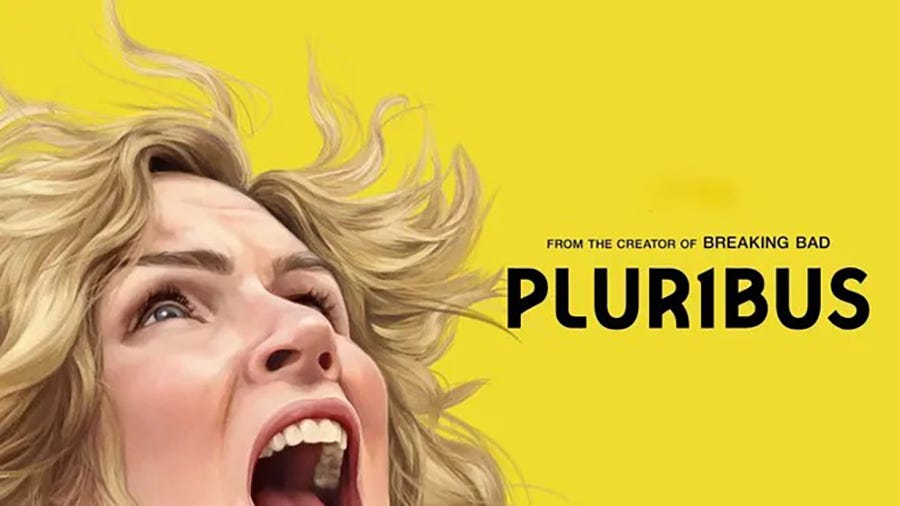
Whew, sorry about the unexpected hiatus. This post has been sitting on my desktop for weeks as a follow up to The Hero with 0.25 Faces. I don’t even remember what I wrote about there, so even if you have already read that post, I’d recommend a quick refresh. If you haven’t read it at all – I mean technically you don’t have to, but you’re probably going to be pretty lost.
Anyways! Here we’re going to delve deeper into this idea that a great way to create a multi-dimensional, complex character is to extrapolate the worst person from the environment of the story that you’ve already created. Also, spoilers for basically all of Pluribus Season 1.
The Post-Post-Apocalypse
The 2000s through the 10s were the era of the apocalypse show and its more visibly smelly and unwashed friend, the post-apocalypse show. The 100, The Walking Dead, Jericho, Battlestar Galactica, Fear the Walking Dead, 12 Monkeys, The Leftovers, Falling Skies, Van Helsing, Under the Dome. And that’s just television. On the movies side, we had The Road, Snowpiercer, Bird Box, A Quiet Place, I Am Legend, 28 Whatever Later, World War Z, The Girl With All the Gifts. I’m sure there are more, as zombies in particular hit pop culture in a big, mindless, slavering way. But even the non-zombie shows tended to share some characteristics with their undead screen brethren, and that was generally dour color palettes mixed with generally dour scripts of We are totally fucked. Mostly, these shows starred characters not exactly known for being cuddle bugs, if not outright misanthropes.
This is not to knock on these shows. It’s a formula that works! Here in the brave new 2020s we’ve still got The Last of Us and Silo and Station Eleven pulling down solid viewership numbers by following these relatively well trod paths. People still like watching stoic heroes and anti-heroes doing gritty things in desaturated environments.
And then there’s Pluribus, which is doing something different. Really different. It’s still the end of the world, but rather than apocalypse by way of flesh-hungry cannibals or nuclear Armageddon, an alien species has infected 99.99999% of humanity and turned them into a deliriously happy and ridiculously agreeable hivemind.
Pluribus is both a dystopia and a utopia story — it’s humanity becoming the force for good and cooperation that we all wish we collectively could be, and the only thing given up to achieve it is er, well, everyone’s humanity. These new Plurbites are peaceful, kind, and responsible in every way. There’s no crime or abuse or general unpleasantness. And there’s no totalitarian enforcement of the rules, either — everyone just wants to be good.
For anyone else on Earth who managed to escape Plurbception, this is a heaven on Earth. The Plurbettes are here to serve this handful of survivors, whatever that means.
So who wouldn’t want to live in a world that is your proverbial oyster, where you’re waited on by the entire human race, hand and foot?
Well, maybe someone who’s already had that.
Carol is the Worst*
Carol Sturka is a successful romance author and, after the events of the Big Plurb, she’s the most miserable woman on the planet. But it’s also possible she was the most miserable woman on the planet before Plurbgate. She’s an alcoholic. She’s prickly, unkind, distrustful, and extremely independent. She hates people. She openly admits that she doesn’t know how to be happy. If you dropped her into the gritty desaturated apocalypse stories of the 2000-10s, she’d fit right in. But because this isn’t a post-war wasteland or a corporate hellscape apocalypse, you’ve got an old character that feels suddenly fresh and interesting.
Normally, you could probably stop there and ride that surprising difference all the way to the bank. But Pluribus does us one better, because Carol isn’t just your average misanthropic character transported from a regular apocalypse story. Her romantasy author backstory isn’t just a throwaway detail to give her some dimension - it interacts deeply with this specific apocalypse setting, and her reaction to her fame explains a lot of the reason why she reacts so differently to the over survivors of Let There Be Plurb.
Because Carol was famous. Carol had fans.
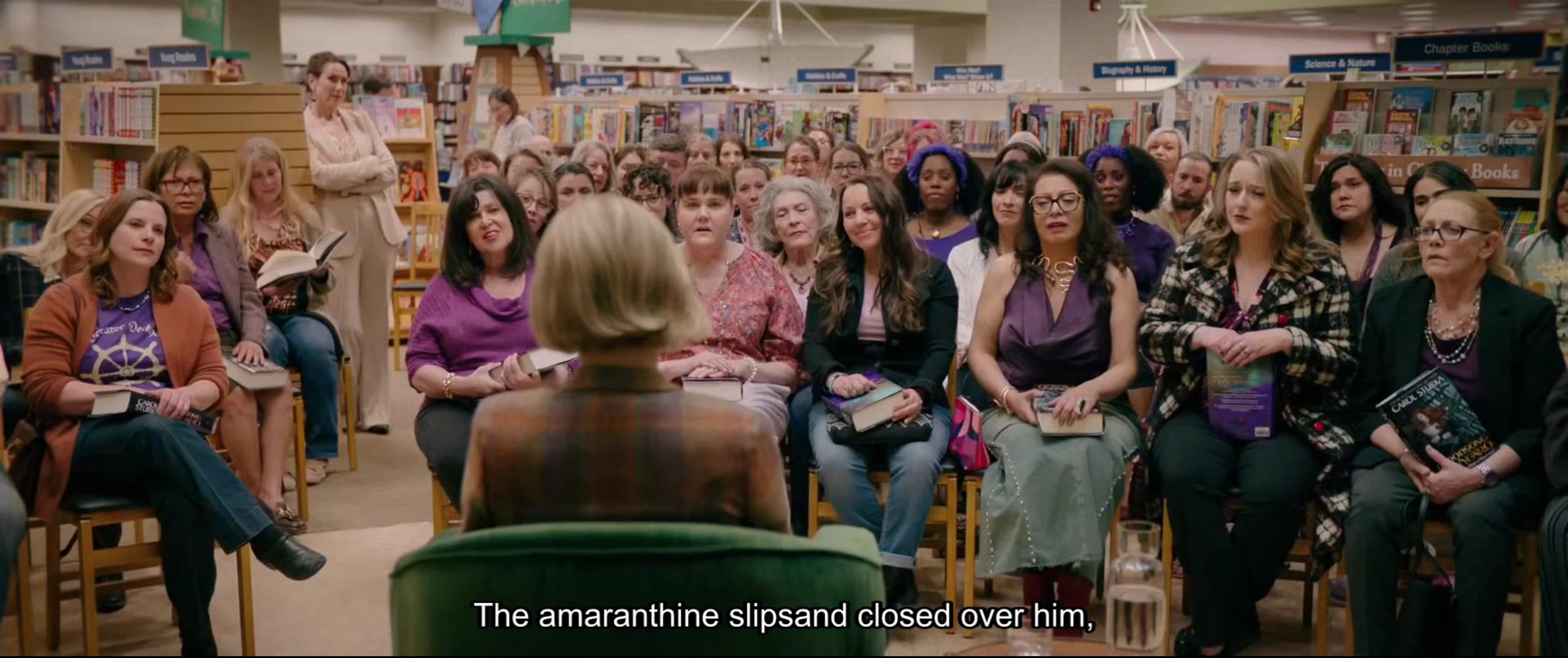
The show opens with her at a book reading/signing, and these first few minutes made me want to crawl in a hole and also wonder why I thought this whole author career thing was a good idea, ever. The stark lighting, the beige carpet, Carol’s obviously dead eyes over her brilliant smile. My god. This opening is soul destroying.
But for a lot of people, that’s the goal of being a writer, right? To have loads of fans at your beck and call, who all know your name and follow every detail of your life, who are all sucking up to you constantly, telling you how great you are? But Carol obviously hates it, and thanks to the Plurbening, the whole world is now her fandom. The fans are always there. Always. Super excited to meet her. Super excited to do things for her. And they really, really can’t wait for her next book.
Only now there’s no Helen for refuge. They took Helen away from her.
Combine this with the revelation that Carol was sent to conversion therapy as a child - here’s another cult, this one not of fandom but of belief - and a complex psychology for this character starts to emerge. Carol learned early that she will only be loved and accepted if she fits into a pre-approved mold, which has only been reinforced by her experiences in publishing; she changed Raban from a woman to a man, and keeps her sexuality a secret in fear of losing her audience. This “fit the mold” deal is exactly the Pluriherd’s offer: love and happiness in exchange for assimilation.
Super Worst*
The characteristics that put Carol into conflict with the Pluribettes and make her the hero of the show are also the flaws that butt her up against the other characters. Someone who refuses to be honest with the people around her out of suspicion of their motivations and a crushing fear of vulnerability, and who then interprets everything everyone else does as motivated by the same impulses, is not going to be someone who’s great at dealing with people. And Carol isn’t! She has none of the skills she needs to get the other survivors on her side against the Pluripack, despite her best efforts. Her inability to convince them, coupled with their resistance to being convinced, reinforce her dislike and distrust of other people, even if she does still care what happens to them.
And she does need help. Despite being smart and capable — she’s unraveling the mysteries of the Plurblings with little more than a barcode from a dogfood bag — she’s also not equipped to handle this situation on her own. But Carol can’t help but be an asshole and make people not want to help her.
That’s what’s so great about this show, and it really goes to show that character and setting can be a kind of chicken or egg creation — you could easily derive this character from the setting (”Who is the worst person to put in my happy hippie commune apocalypse?”) or the setting from the character. Because Carol Struka, while a perfectly adequate character in a regular apocalypse, is a fantastic character in her own personal Upside Down world.
The show is really a masterclass on how to make an unlikable character both compelling and sympathetic. Oh, and bonus point for the big plurb and the plurbening. 🤣
Going forward, I recommend each season of the show be named thusly.
Pluribus S1: The Big Plurb
Pluribus S2: The Plurbening
Pluribus S3: Plurb Harder
Pluribus S4: 1 Plurb, 2 Pluribus